
RESIDENTIAL POTABLE RAINWATER HARVESTING SYSTEM
WEAVERVILLE, NORTH CAROLINA
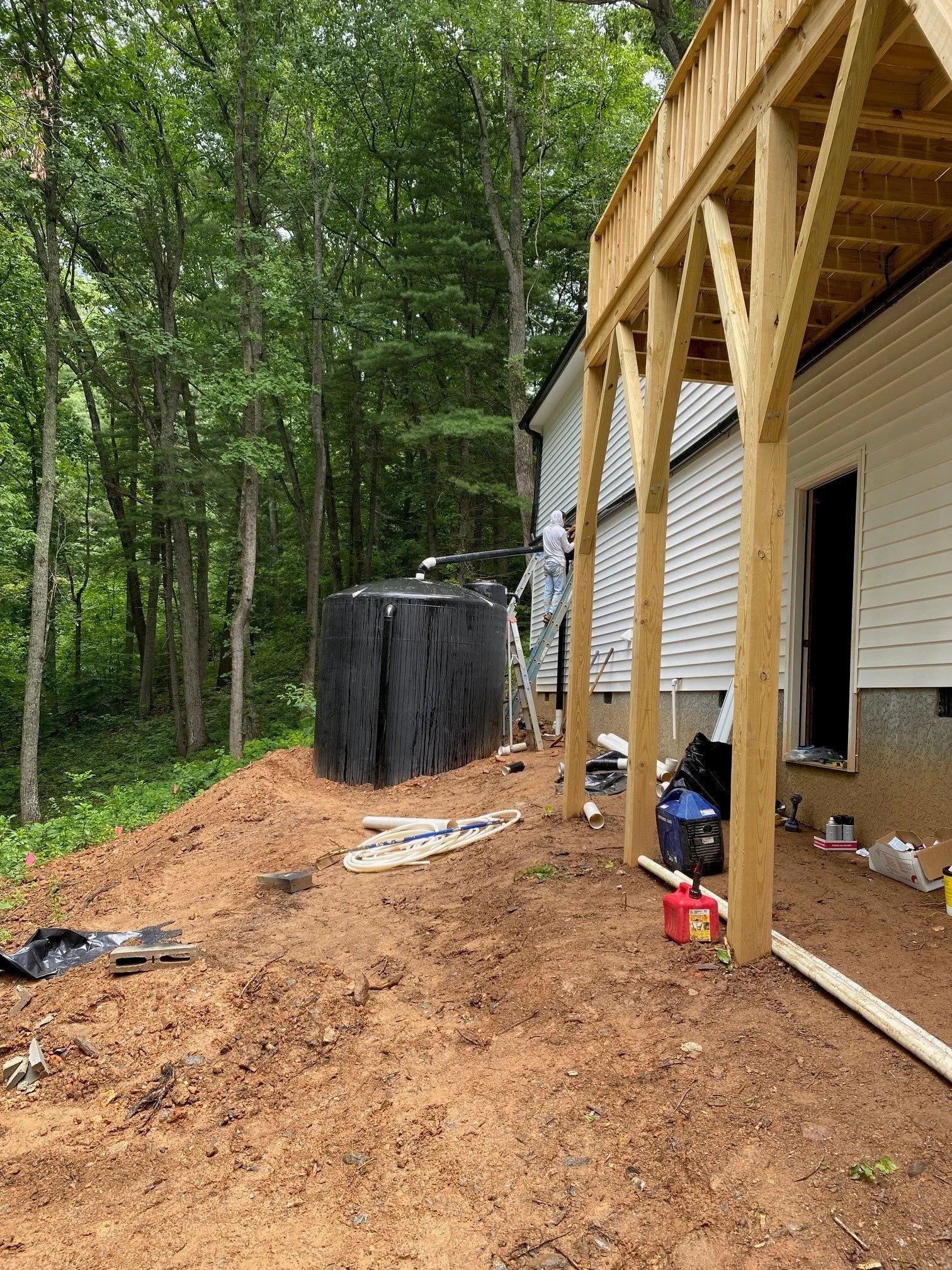
For a new residence near Weaverville, North Carolina, conventional groundwater development proved unsuccessful when a 905-foot-deep well yielded only approximately five gallons of water per day. Rather than pursuing additional costly drilling with uncertain results, the project team turned to rainwater harvesting as an alternative source of potable water.
Blue Earth Engineering was retained by 2020 Builders to provide engineering evaluation, system planning, and permitting assistance for a residential rainwater harvesting and treatment system designed to meet the home's domestic water needs.
Evaluating Rainwater Supply and Demand
Blue Earth conducted a long-term water supply simulation using 20 years of historical rainfall data and the North Carolina State University Rainwater Harvester model. The analysis evaluated the relationship between roof collection area, storage capacity, household water demand, and seasonal rainfall variability.
The system captures rainfall from the home's approximately 1,580-square-foot roof and directs it into two interconnected 3,000-gallon cisterns, providing a total storage capacity of 6,000 gallons.
Modeling indicated that the system could meet approximately 95% of annual household water demand at a consumption rate of 100 gallons per day. With water conservation reducing consumption to 80 gallons per day, the model predicted that rainwater could meet 100% of the household's water needs over the historical simulation period.
Treatment for Potable Use
To make collected rainwater suitable for domestic use, the system incorporates multiple stages of filtration and treatment. Rooftop runoff passes through downspout filters before entering the storage cisterns. Water is then pumped through additional sediment filtration and ultraviolet disinfection before distribution to household fixtures.
The system was designed to meet the ARCSA/ASPE/ANSI 63 standard for rainwater catchment systems, including requirements applicable to potable water use. Water-level monitoring also supports household conservation, particularly during extended dry periods.
An Alternative Approach to Residential Water Supply
This project demonstrates how carefully designed rainwater harvesting systems can provide a viable alternative water source for homes where groundwater supplies are limited or unreliable.
By combining long-term rainfall analysis, appropriate storage capacity, advanced treatment, and water conservation, the project illustrates a decentralized approach to residential water supply that can reduce dependence on groundwater while making productive use of rainfall.
Blue Earth has successfully designed and permitted both potable and nonpotable rainwater harvesting systems in various counties in Western North Carolina.
Project Team
Client/Builder: 2020 Builders, LLC
Engineering and Permitting: Blue Earth Engineering
Rainwater System Supplier and Integrator: Rainwater Management Solutions
Installation Contractor: Asheville Drainage + Rainwater Harvesting